Plans and actions
How usage is measured, what each plan includes, and what happens when you reach your limit.
Nodest plans are measured in actions per month. Automations themselves are unlimited on every plan, including the free one — what scales with your plan is how much work those automations do.
The three plans
Starter is free, permanently. One workspace, 100 actions a month, and automations of up to two steps — a trigger and one action. It's enough to connect a tool and see a real automation working end to end, and it doesn't expire or ask for a card.
Professional starts at €29/month. Three workspaces, automations up to 100 steps, 30 days of run history, and the steps that make automations conditional: filters, branches, and delays.
Business starts at €79/month. Five workspaces, 90 days of run history, team access so you can invite colleagues into a workspace, and cross-site automation for connecting several WordPress sites in one automation.
Professional and Business are each sold in volume tiers, from 2,500 actions a month up to 2.5 million. Pick the plan for the features you need, then the tier for the volume — moving up a tier later doesn't change which features you have.
What each plan includes
| Starter | Professional | Business | |
|---|---|---|---|
| Actions per month | 100 | 2,500 – 2,500,000 | 2,500 – 2,500,000 |
| Workspaces | 1 | 3 | 5 |
| Steps per automation | 2 | 100 | 100 |
| Run history | 7 days | 30 days | 90 days |
| Filters, branches, delays | — | ✓ | ✓ |
| Team access | — | — | ✓ |
| Cross-site automation | — | — | ✓ |
Current prices for every tier are on the pricing page.
What counts as an action
Every step that runs to a result counts as one action. That includes the trigger that started the run, and it includes filters, branches, and delays — not just the steps that call an external tool.
Two things follow from that, and they surprise people:
- A step that fails still counts. It did the work; the tool at the other end rejected it.
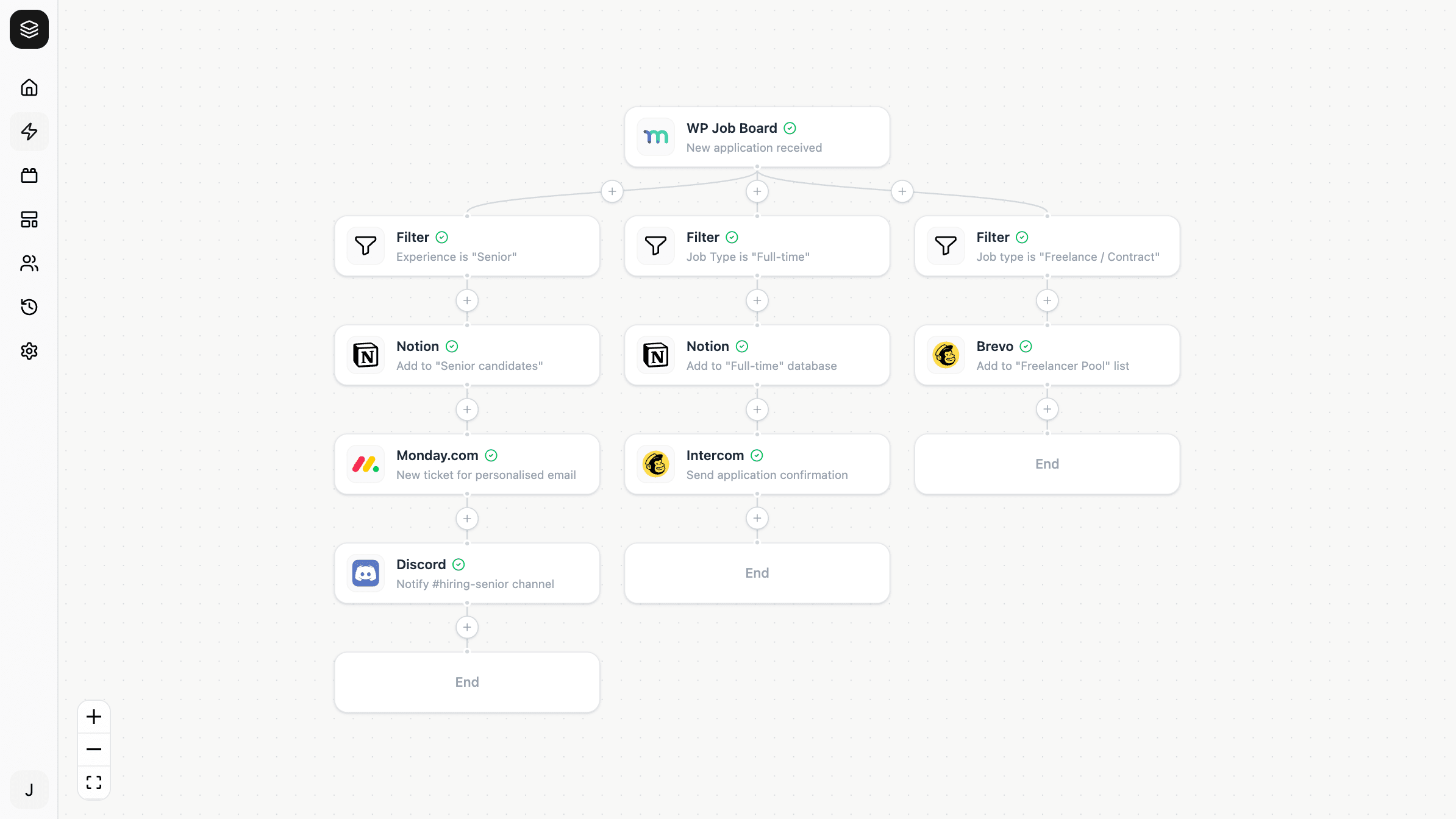
- A step that's skipped doesn't count. When a filter stops a run, the steps after it never execute, so you're not charged for them.
A five-step automation therefore costs five actions per run when everything runs, and fewer when a filter cuts it short.
The allowance is shared
Your allowance belongs to the organization, not to any one workspace. Every workspace draws from the same monthly pool, so a busy workspace can consume the allowance the others were counting on.
The allowance resets at the start of each billing cycle. On a yearly plan it still resets monthly — a year's worth isn't available upfront.
Warnings and running out
The organization owner is emailed at 80% of the monthly allowance, and again at 100%. The 80% email projects, at your current rate, roughly when you'll hit the limit.
At 100%, automations stop running until the cycle resets or you add capacity:
- Incoming webhooks are discarded rather than queued — events that arrive while you're out of allowance are not replayed later.
- Scheduled polling stops checking for new items.
- A run already waiting on a delay fails when the delay ends.
Stopping cleanly is deliberate: automations halt rather than half-running and leaving records inconsistent across your tools.
Adding capacity without upgrading
If you need more actions but not a bigger plan, buy action credits at €12 per 1,000 actions. They're added to the current cycle and your subscription doesn't change.
If you're buying credits most months, a higher tier is usually cheaper. Credits are only valid while you have an active paid subscription — they lapse if you drop back to Starter.
Changing plan
Upgrades apply immediately; downgrades apply at the end of the period you've paid for.
A downgrade applies the new limits to what you already have: workspaces over the limit become read-only, and automations that exceed it are paused rather than deleted. You'll get an email listing exactly what changed, and everything returns if you upgrade again.