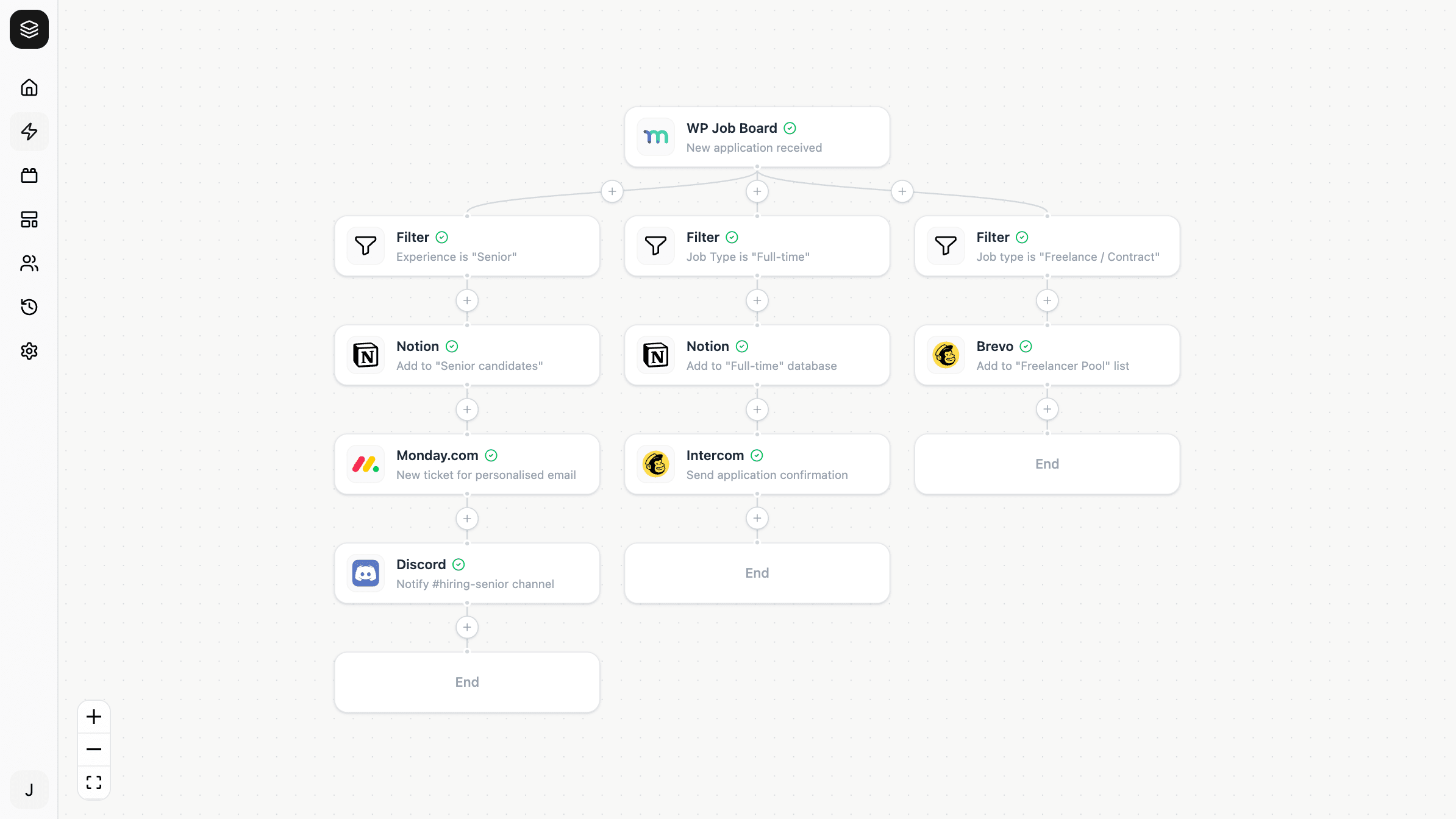
Automations, runs, and nodes
The vocabulary you will see throughout Nodest, and how the pieces relate to each other.
Nodest uses a small set of words consistently across the app, the docs, and your billing. This page defines each one and shows how they nest.
| Term | What it is |
|---|---|
| Organisation | Your account. Owns the subscription and the people. |
| Workspace | Holds automations, connections, and run history. An organisation can have several. |
| Integration | Nodest's support for one external tool, such as WooCommerce or Notion. |
| Connection | Your authorised link to a tool. One per integration, per workspace. |
| Automation | A workflow you build: steps and the order they run in. |
| Node | A single step inside an automation. |
| Trigger | The node that starts an automation. Every automation has exactly one. |
| Action | A node that does something in a connected tool. |
| Run | One execution of an automation, caused by one event. |
| Template | A ready-made automation you copy into your workspace. |
How do the pieces nest?
From the outside in:
Organisation → Workspace → Automation → Nodes
Your organisation is the account. Inside it, workspaces are self-contained working areas — each with its own connections and its own automations. Inside a workspace, each automation is a sequence of nodes. When an automation fires, it produces a run.
The one thing that sits slightly to the side is the integration/connection pair, which is worth getting straight because the two are easy to confuse.
What's the difference between an integration and a connection?
An integration is Nodest's support for a tool — it defines which events that tool can start an automation with, and what Nodest is able to do inside it. Integrations are the same for everyone; they're part of the platform.
A connection is your authorised link to that tool: your Notion workspace, your WooCommerce store. It holds the credentials.
So: the Notion integration exists whether or not you use it. Your Notion connection exists once you authorise it. A workspace holds a single connection per integration, which is why connecting Notion once makes it available to every automation in that workspace.
What's the difference between an automation and a run?
An automation is the definition; a run is one execution of it. The recipe and one time you cooked it.
This distinction matters when you're debugging. Editing an automation changes what future runs do — it never rewrites runs that already happened. Those stay as a historical record of what actually executed, with the data each step received.
What's the difference between a trigger and an action?
A trigger listens; an action does. Every automation has exactly one trigger, at the start, and it decides both when the automation runs and what data the rest of the steps get to work with. Actions come after, and there can be as many as you need.
Not every integration offers both. Plenty of tools can be written to but have no way to notify an external service when something changes — those have actions but no triggers. Check the direction you need before planning a workflow.
What are the other node types?
Beyond triggers and actions, four node types control flow rather than doing work:
- Filter — continues only when conditions are met, otherwise that path stops
- Branch — splits into paths that are evaluated separately
- Delay — pauses for minutes, hours, or days, then resumes
- Sub-automation — calls another automation as a reusable step
Which of these affects my bill?
Plans are measured in actions per month, so what consumes your allowance is the work your runs perform — not how many automations, workspaces, or connections you have. Automations are unlimited on every plan, including the free one.