Using integrations
How to find what a tool can do in Nodest, why triggers and actions aren't symmetrical, and what to do when a tool is missing.
An integration is Nodest's support for one external tool. It defines what that tool can start an automation with — its triggers — and what Nodest can do inside it — its actions. Connecting the tool makes both available to every automation in that workspace.
Finding what a tool supports
Every integration has a page in the integration library listing its triggers and actions with a description of each.
Those pages are generated from the live catalogue, so they always show what's actually available right now rather than what was true when someone last updated a document. If a trigger is listed there, it exists.
Triggers and actions aren't symmetrical
This is the thing to check before planning a workflow.
A tool Nodest can write to isn't necessarily a tool Nodest can listen to. Plenty of tools have a perfectly good API for creating records but no way to notify an external service when something changes. Those integrations have actions but no triggers.
So ask which direction you need:
- To react to something happening in a tool, it needs a trigger.
- To do something in a tool, it needs an action.
If the tool you want to react to has no triggers, start the automation somewhere that does — usually your WordPress site — and involve the other tool as an action.
What if an integration has no triggers at all?
It's still fully usable, just not as a starting point. Notion is a good example of the pattern: you may want things to land in it far more often than you want it to start something.
WordPress plugin integrations
Integrations for WordPress plugins behave differently from standalone SaaS ones in two ways worth knowing:
- They authenticate through the site, not separately. WooCommerce, Gravity Forms, MemberPress and Easy Digital Downloads all run on the connection to the WordPress site they're installed on.
- Their events come from the Nodest plugin rather than a third-party API, which is why they arrive in real time.
The plugin also has to be installed and active on the connected site for its triggers to appear. If you activated it after connecting, reconnect so Nodest re-checks what's available.
Combining several tools
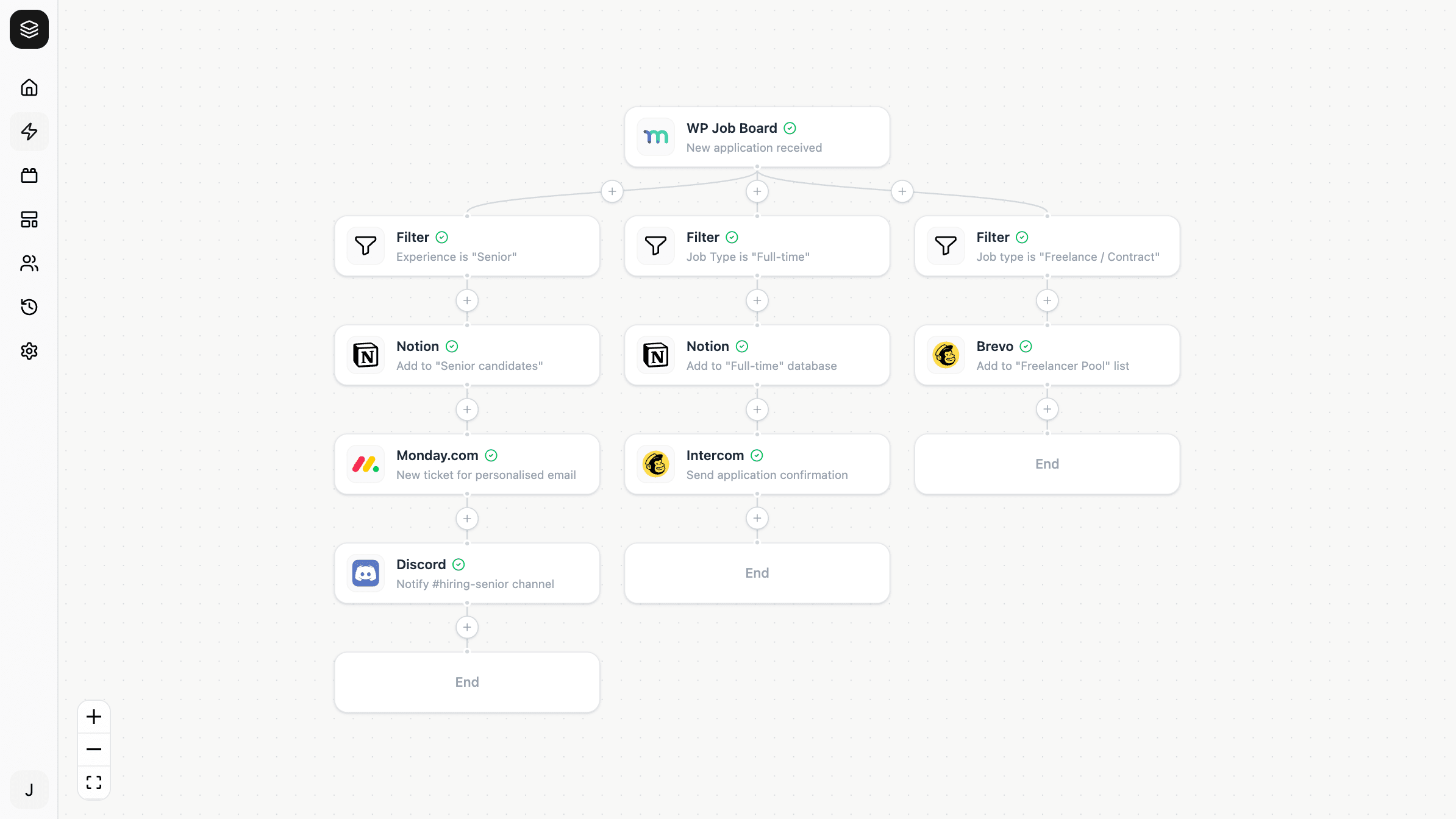
Nothing restricts an automation to two tools. A single workflow can take a WooCommerce order, filter it, create a record in one tool, post a message in another, and wait a day before doing something in a third.
Because connections are per workspace, once a tool is connected it's available to every automation there — you don't reconnect per workflow.
How do I know what data a trigger gives me?
Test the trigger. Nodest fetches a real record from your connected tool and saves it as sample data, and from that point the fields are listed in the variable picker for every later step.
That's more reliable than reading a field list, because you see the actual values your account produces. See Testing an automation.
What if the tool I need isn't there?
You can request an integration. Requests are prioritised by demand, so the more people asking for a tool, the sooner it gets built.
In the meantime, check whether the tool can be reached another way — many services can receive data from a tool that is supported, or accept an email or webhook that another step in your automation can produce.