Combining several tools
Using more than two tools in a single automation, in any direction.
Nothing restricts an automation to two tools. One event can create a record in one place, send a message somewhere else, and update a third system — all in one workflow, in the order you choose.
Because connections belong to the workspace, every tool you've connected is available to every automation there. You don't reconnect per workflow.
The basic shape
One trigger, then as many actions as you need. They run in order, each waiting for the one before it.
- Trigger — Order placed in WooCommerce
- Action — add the customer to your email list
- Action — create a record in your project tool
- Action — post a summary to your team chat
Every step can use data from the trigger, so all three actions see the same order.
Chaining: when a step needs the previous step's result
Steps can use output from any earlier step, not just the trigger. That's what makes real chains possible.
If step 2 creates a record and the tool returns its ID, step 3 can use that ID — to attach a file to it, to link it from somewhere else, to reference it in a message. Test step 2 first so its response is available in the variable picker.
This is also why order matters beyond taste: a step that depends on another's output has to come after it.
Doing different things for different data
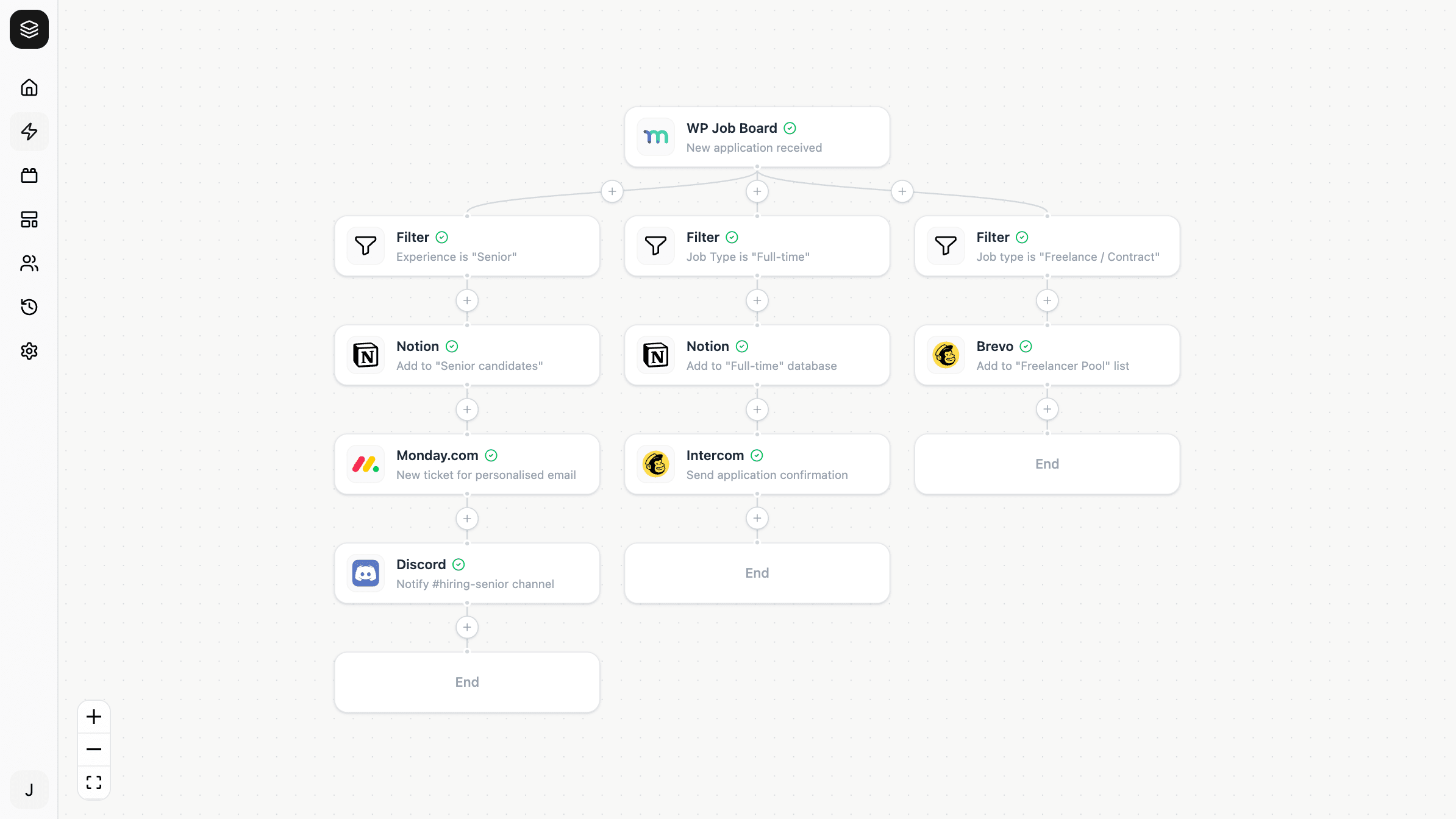
Use a branch when the same event should reach different tools depending on the data. High-value orders go to the sales channel and the CRM; everything else just goes to the mailing list. Each path has its own conditions and its own steps.
Use a plain filter when it's one path with a gate on it.
Spacing things out
A delay between steps lets one workflow span days. Add the customer to the list immediately, wait a week, then create a follow-up task — one automation, not three.
What happens if one tool fails?
This is the part worth understanding before you build something long.
Steps that already ran are not undone. If step 2 succeeded and step 3 fails, the run stops at step 3 — but the record from step 2 exists. There's no rollback, because Nodest can't un-send a message or un-create a row in someone else's system.
So a failed run in a multi-tool automation usually means a partially applied workflow, and that's what you're inspecting for when you open the run history: not just what failed, but what had already happened before it did.
Two habits that help:
- Put the step that's most likely to fail early. If a tool is fussy about required fields, finding out before three other systems have been written to is cheaper.
- Put irreversible or externally visible steps last. Creating an internal record is easy to clean up. Emailing a customer isn't. Ordering so the customer-facing step is final means a mid-run failure stays invisible to them.
Reaching another site
If part of the work belongs on a different site, that's a sub-automation call rather than another action — each site lives in its own workspace with its own connections. Cross-workspace calls need a plan that includes cross-site automation.
Keeping it readable
Long automations get hard to follow. Two things keep them manageable:
- Name your steps for what they do in your process — "notify retention team" beats "Discord action".
- Extract repeated sequences into a sub-automation once the same three steps appear in a third workflow.
A worked example
New customer onboarding across four tools:
- Trigger — Customer created in WooCommerce
- Filter — continue only for customers with a company name
- Action — create a CRM contact (returns a contact ID)
- Action — create an onboarding task, linked to that contact ID
- Action — post to the sales channel
- Delay — 3 days
- Action — send the check-in email
The filter runs before any work is done. Step 4 chains off step 3's ID. The customer-facing email is last, so a failure in steps 3–5 never reaches them.